
AMCC in Juneau: Advocating for Fishing Communities and Charting the Path Ahead
Updated: Feb 27
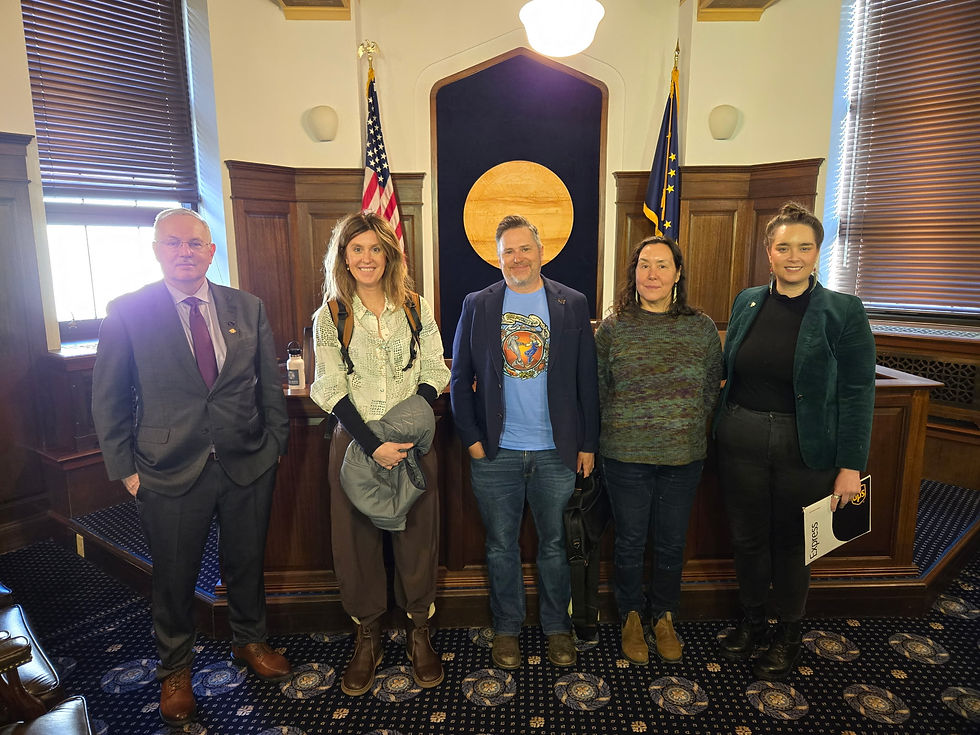
Alaska Marine Community Coalition board and staff recently traveled to Juneau for a productive and energizing Fish Week of advocacy, connection, and planning on behalf of Alaska’s fishing communities.
During our legislative fly-in, AMCC representatives met with lawmakers and staff to highlight the urgent needs of working waterfronts and fisheries infrastructure across the state, advance conversations on trawl accountability, and underscore the vital role fishing communities play in Alaska’s economy, culture, and food security. These meetings ensured that the voices of coastal communities were present in policy discussions that will shape the future of our fisheries.
While in Juneau, AMCC also hosted a launch event celebrating two major milestones: our organizational rebrand and the kickoff of Fish First, Party Second, our candidate education and voter engagement initiative focused on keeping fisheries issues front and center in upcoming elections. The gathering brought together partners, fishermen, policymakers, and supporters in a shared commitment to Alaska’s marine future.
The trip also included a Board of Directors meeting to guide AMCC’s strategic direction for the year ahead. Board members worked closely with staff to refine priorities, strengthen programs, and ensure the organization remains responsive to the evolving needs of Alaska’s fishing communities.
We returned from Juneau energized and deeply grateful for the opportunity to advocate directly, build relationships, and continue advancing solutions that put fish and fishing communities first.
A New Coalition for Trawl Accountability in Alaska’s Waters
Alaska’s fisheries are built on a simple promise: our public resources will be managed sustainably, transparently, and fairly for the benefit of present and future generations. Upholding that promise requires rules that are not only well-intended on paper but clear, enforceable, and trusted on the water. That is why AMCC has partnered with the Alaska Healthy Habitat Alliance (AHHA), a growing coalition of fisheries organizations, community groups, and conservation advocates working to strengthen accountability in Alaska’s trawl fisheries.
AHHA was formed in response to a long-standing gap between how pelagic (midwater) trawl gear is defined in regulations and how it truly operates in practice. Under Alaska law, pelagic trawl gear in state waters is defined as gear that does not contact the seafloor. Yet there is currently no practical way for managers, enforcement, or the public to verify compliance with that standard while fishing is underway. Without verification tools, the system defaults to trust-based compliance, which is an approach that undermines regulatory credibility, fuels user conflict, and increases risks to benthic habitat and salmon.
The Proposals Before the Board of Fisheries
At the March Statewide Finfish meeting, the Alaska Board of Fisheries will consider Proposals 163, 164, and 165, submitted by AHHA to address this accountability gap. Together, these proposals form a practical, science-based framework to ensure that Alaska’s existing rules governing pelagic trawl gear are enforceable and meaningful.
Proposal 163: Prove it’s Midwater
Proposal 163 would treat trawl gear as bottom-contact gear unless operators can demonstrate that it is fishing off the seafloor. This approach reflects a core principle of Alaska fisheries management: permit holders are responsible for operating legally at all times. When compliance depends on how gear is fished — not just how it is designed — it is reasonable to require it to be fished as intended.
This framework also promotes fairness across gear types. Many Alaska fishermen operate under strict, verifiable rules. Allowing pelagic trawl operations to function in a regulatory gray zone erodes confidence in the system and creates uneven expectations among user groups.
Proposal 164: Monitoring to Make the Definition Enforceable
Proposal 164 would require monitoring technology capable of verifying whether pelagic trawl gear contacts the seafloor. This proposal provides the missing piece in the current system: a practical compliance pathway. Monitoring is not about punishment. It is about transparency. When compliance is measurable, conflict decreases, trust improves, and responsible operators benefit from documented proof of lawful operation.
Clear standards, auditable protocols, and predictable enforcement would transform the pelagic definition from a paper rule into an operational one.
Proposal 165: Salmon Excluders as a Baseline Best Practice
Proposal 165 would require salmon excluders in pelagic trawl nets operating in state waters. Salmon are a statewide resource with profound cultural, economic, and food-security importance. Where avoidable salmon encounters occur, Alaska should require available mitigation tools to reduce risk. This proposal aligns state waters with modern bycatch-reduction practices.
Why This Matters
These proposals are not about eliminating trawl fisheries. They are about ensuring that all fisheries operate under clear, enforceable standards that protect habitats, reduce bycatch risk, and maintain public confidence in management. Alaska’s fisheries depend on healthy seafloor ecosystems and abundant salmon populations. When rules cannot be verified, both conservation outcomes and social trust suffer.
Accountability also benefits fishermen. A transparent system replaces suspicion and controversy with evidence. It protects operators who are following the rules and reduces the likelihood of sweeping restrictions driven by unresolved conflict.
A Critical Moment for Alaska Fisheries
The March Statewide Finfish meeting represents a pivotal opportunity to strengthen Alaska’s approach to habitat protection and responsible fishing practices. AHHA’s proposals offer a balanced path forward grounded in science, fairness, and practical implementation.
AMCC is proud to stand with AHHA and its member organizations in advancing solutions that protect Alaska’s marine ecosystems and the communities that depend on them. Ensuring that “midwater” truly means off-bottom is a necessary step toward accountable, resilient fisheries management.
How You Can Get Involved
Public engagement is essential in the Board of Fisheries processes. If you care about healthy habitats, sustainable fisheries, and fair management, now is the time to act.
Learn more about the Alaska Healthy Habitat Alliance
Submit written comments to the Board of Fisheries
Sign the public petition supporting trawl accountability
Share information with your networks
Attend AHHA’s Mug Up event on March 16 at 5:30 p.m. at 49th State Brewing in Anchorage!
Join us and testify in person to the Board of Fisheries!
Together, we can ensure Alaska’s fisheries remain a global model not only for productivity but also for integrity, transparency, and stewardship.


